How Stress Is Quietly Sabotaging Your Workouts and Results
Stress and weight loss are linked more than most people realize. See how high stress hurts your workouts and recovery, and what a trainer can do about it.
By
October 20, 2026


Every so often a client walks in, sits down for the check-in, and says some version of the same thing: "I'm doing everything right and nothing is moving." They're training three times a week. They're eating reasonably. They've tracked their food. And the scale, the mirror, and the weights on the bar have all gone flat. When I ask how work has been, the answer is usually a long exhale. A new boss, a sick parent, a house project that turned into a money pit. The workouts aren't the problem. The rest of their life is eating the results, and stress and weight loss are far more tangled together than most people expect.
Here's what's actually going on, and what we do about it at our private personal training studio on James Island.
Stress is not just a feeling. Your body treats a brutal deadline and a hard squat session as the same kind of demand, and it only has one recovery budget to pay for both. When life is already spending most of that budget, a workout that would have been fine in a calm month can leave you flat, sore for days, or oddly wired and tired at the same time.
The signs tend to be consistent. Weights that felt manageable last month feel heavy. Your heart rate runs higher at the same effort. You wake up before the alarm and can't get back to sleep. Warm-ups feel like they take forever and the last set is a fight. None of that means you got weaker. It usually means your recovery capacity shrank, and the workout didn't change to match.
A client of ours, an accountant, hit this every spring. Right around the first week of March her squat numbers dropped, her sleep fell apart, and she'd get frustrated and add more sessions to fix it. Through tax season we did the opposite. Same three days, but shorter sessions, lighter loads, and one of them became a walk and some mobility work. By May she was back to her old numbers without ever having lost the habit. Cutting back kept her training. Pushing harder would have knocked her out for six weeks.
Chronic stress doesn't make fat loss impossible, but it stacks the deck in a few quiet ways.
Sleep goes first. People under heavy stress tend to sleep less and sleep worse, and short sleep makes hunger feel louder and cravings harder to ignore. That is why a stressful week so often ends with a late-night snack run for something salty or sweet. It isn't a character flaw. It's a tired brain looking for quick energy.
Eating patterns shift too. Meals get skipped until 2pm, then the evening turns into grazing. Protein drops, convenience food goes up, and a glass or two of wine becomes the way to switch off. None of it is dramatic on its own, but over a few weeks it adds up to a deficit that disappears or a surplus nobody noticed.
Then there's the water-weight issue. A hard week combined with poor sleep can make the scale jump a pound or two with no real change in body fat. People see that number, feel worse, and stress more. If you only judge progress by the scale during a rough patch, you can talk yourself out of a plan that was working.
The answer is rarely "push harder." A few adjustments make a real difference.
Lower the intensity before you lower the frequency. Showing up still matters. If you'd normally finish a set with two reps left in the tank, stop with three or four. You still get the movement and the habit, and you don't dig the recovery hole deeper.
Keep the sessions shorter, not skipped. A focused 30 minutes of squats, rows, and carries beats an hour of grinding through half-hearted reps. Strength is easier to hold than to build, so a lighter stretch is a fine time to maintain.
Add easy movement on purpose. A 20-minute walk after dinner does more for stress and sleep than another high-intensity round. It also helps with appetite later in the evening.
Protect sleep like a training session. Same bedtime, screens down earlier, and caffeine cut off by early afternoon. Seven hours that you can count on helps more than a perfect program at five.
Hold the protein line. When everything else feels chaotic, hitting your protein at breakfast and lunch is one decision you can control. It steadies energy and keeps appetite from running wild by evening.
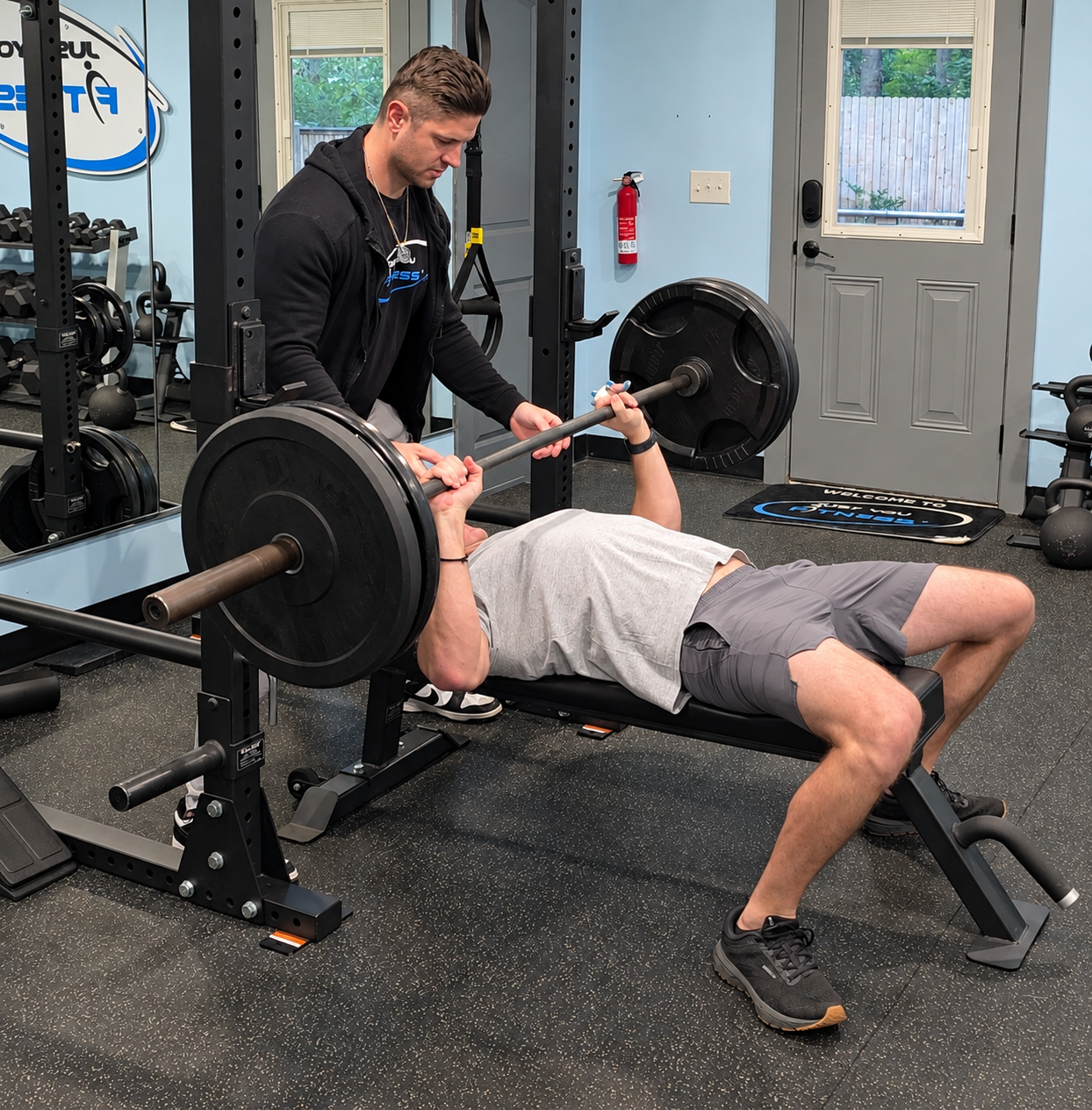
On a calm day, almost any plan works. When you're stressed, you need someone who can read the room. In a private session your trainer sees it within the first two minutes: the shoulders are tight, the answers are short, the warm-up takes longer than usual. That's the moment to change the plan on the spot, instead of grinding through what was written on paper last Tuesday.
This is also where an ongoing relationship pays off. In our Premium Coaching Program, the training adjusts around what is going on in your life, whether that's a travel week, a deadline crunch, or a family situation. Monthly check-ins give us a chance to step back and see the pattern, not just the single bad session, and workouts built for travel keep the habit alive when your normal routine falls apart.
You can't remove stress from a busy life in Charleston, but you can stop it from quietly undoing the work you're putting in. Most of the time, the fix is smaller and calmer than people expect.
Feeling like your results stalled while life got louder? Book a free session at our James Island studio and we'll look at what your training and your week need right now.