Do You Need to Be Sore for a Workout to Count?
Do you need to be sore after a workout for it to count? Not at all. Here's what soreness really means, and better ways to tell your training is working.
By
October 27, 2026


A few times a month, someone finishes a session at our studio, feels great, and then texts us the next morning with a worried tone: "I'm not sore at all. Did that even work?" It's one of the most common questions we get in personal training, and the honest answer is that being sore after a workout tells you much less than people think. Some of the best training weeks of a client's year leave them feeling completely normal the next day. Some of the worst ones leave them barely able to sit down.
Here's what soreness actually is, why it fades, and what to watch instead.
That achy, stiff feeling that shows up a day or two after training has a name: delayed onset muscle soreness, or DOMS. It usually starts 12 to 24 hours after a workout, peaks somewhere around 24 to 72 hours, and then fades. It tends to show up when you do something your body isn't used to, like a new exercise, a heavier load, or a movement with a long lowering phase, such as the down part of a squat or a Romanian deadlift.
The key phrase there is "not used to." Soreness is mostly a sign of novelty, not of effort or progress. It's your body reacting to a surprise. Once the surprise wears off, the soreness does too, even though you're still training hard and getting stronger.
I had a client a few years back, a retired teacher in her sixties, who came in worried in her sixth week. In week one she'd been sore for four days after leg day and had loved it. By week six she barely felt a thing, and she was convinced she'd stopped making progress. She hadn't. She'd added weight to her goblet squat, moved from a box squat to a full one, and was doing more reps with better control. Her body had simply adapted, which is the whole goal.
This is the part that surprises most people. The more consistently you train, the less sore you tend to get from the same session. Your muscles adjust to the movement, the nervous system gets more efficient, and the same workout creates less disruption than it did the first time. That's called the repeated bout effect, and it's a sign your body is adapting.
It also explains why soreness comes roaring back when you do something new. Switch from a leg press to lunges, or take two weeks off for a vacation, and the soreness returns even though you're fitter than you were a month ago. That doesn't mean the new workout is better or the old one stopped working. It means the stimulus changed.
If soreness isn't a reliable scoreboard, what is? A few things are far better.
Are the numbers moving? More weight, more reps, better control, or the same load feeling easier. Even small changes count. Adding five pounds to a row or two reps to a set over a month is real progress.
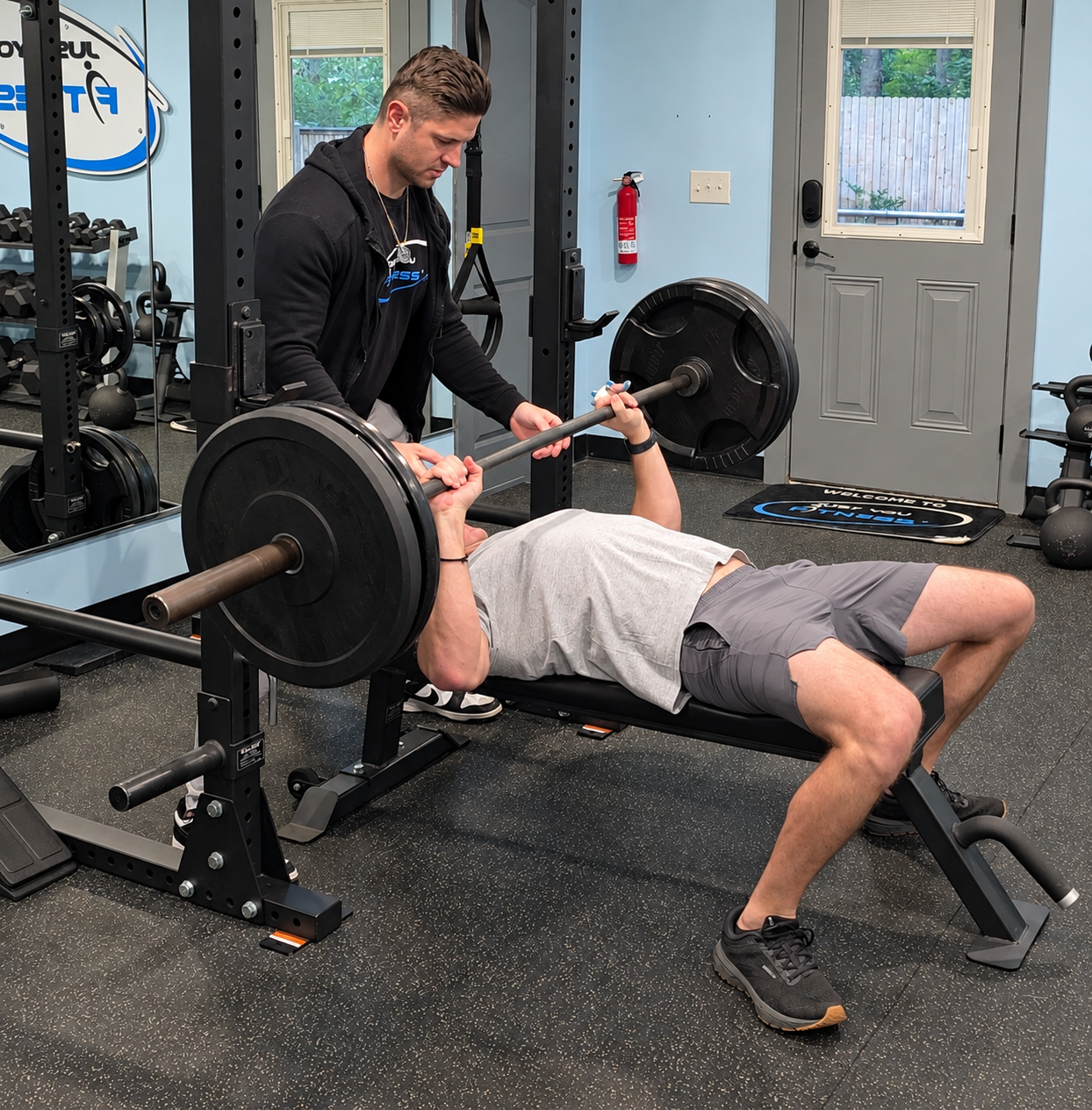
Is your technique getting cleaner? A squat that stays steady all the way down, a hip hinge that finally clicks, a push-up you can do from the floor. This is one of the main reasons we like private personal training. Someone is watching every rep and can tell you when something has quietly improved.
How do you feel in daily life? Carrying groceries, climbing stairs, getting off the floor, playing with kids or grandkids. These everyday tasks feel easier long before the mirror shows much.
How's your energy and sleep? Many people notice better sleep and steadier energy within a few weeks of consistent training, well before any body changes show up.
Are you recovering well between sessions? If you can train again two days later feeling ready, that's a good sign you're pushing at a level you can repeat.
Being very sore isn't a badge of honor, and chasing it can backfire. If you can't straighten your arms, can't walk down stairs, or are still hobbling five days later, the workout was probably too much too soon. It can also derail your next sessions, and missed sessions cost more progress than a slightly easier workout would have.
There's a difference between soreness and pain. Soreness feels like a dull ache across a whole muscle and eases as you move. Sharp pain, pain in a joint, pain that gets worse with movement, or swelling is something else, and it deserves a closer look. And if you ever have extreme muscle pain with significant swelling or very dark urine after an intense workout, that needs medical attention right away, not another training session.
When clients are brand new, we deliberately keep the first couple of weeks manageable. The goal is to build the habit and learn the movements, not to leave you unable to walk down your front steps. A little stiffness the next day is fine. Being wrecked for four days isn't.
From there, we change one thing at a time: a little more weight, a few more reps, a slower lowering phase, or a new variation. That keeps progress steady without chasing soreness. It's the kind of adjustment that's much easier when a trainer is paying attention to how you move and how you're feeling session to session, rather than guessing alone.
If you train in Charleston and have been judging your workouts by how much you ache, try watching your numbers, your form, and your everyday energy instead. They tell you a lot more.
Not sure if your current workouts are doing what they should? Book a free session at our James Island studio and we'll look at what your training is actually giving you.